Lake Nakuru, Where the Water Turns Pink With Flamingos
A short drive from Nairobi delivers rhinos, flamingos and waterfalls. Plan a rewarding day trip on a modest budget.
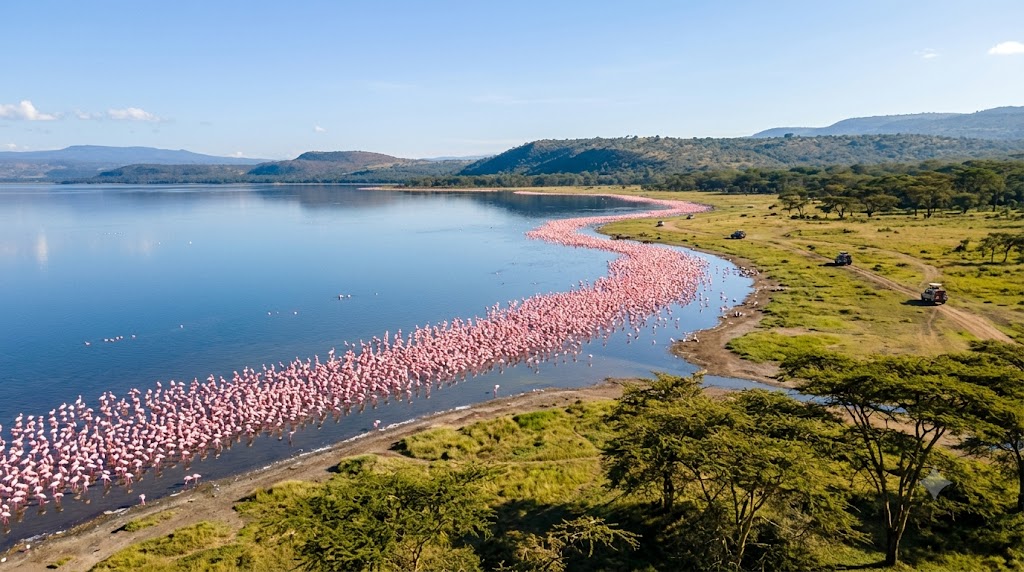
Everyone has seen the photo. That impossible carpet of pink stretching along a shoreline in Kenya, so dense it looks photoshopped, so surreal that people genuinely ask if it's real. It is real, or at least it was, and still can be, depending entirely on timing, water chemistry, and a fair bit of luck. That photo is Lake Nakuru, and if you're planning a trip to Kenya's Rift Valley, you need to know upfront that the postcard version of this place isn't guaranteed. What you get instead is something arguably better: one of the most densely packed wildlife sanctuaries on the continent, crammed into a park so small you could drive its entire circuit before lunch.
Lake Nakuru National Park sits in Kenya's Great Rift Valley, just a short hop from Nakuru town, and it has built its global reputation on flamingoes, yes, but also on rhinos, lions, and a landscape that shifts from soda lake to acacia woodland to cliff-top forest within a matter of kilometers. It's compact. It's intense. And frankly, it rewards visitors who understand what they're looking at rather than just pointing a camera and hoping.
What Is Lake Nakuru National Park?
Location and geography
The park sits roughly 140 kilometres northwest of Nairobi, tucked into the floor of the Great Rift Valley near Nakuru town, which has grown into a genuine urban center pressing right up against the park boundary. That proximity to a city is unusual for a Kenyan national park, and it matters more than people realize, something I'll get back to later. According to the official Kenya Wildlife Service overview, the park was gazetted back in 1968 and now covers about 188 square kilometres, sitting at an elevation of roughly 1,754 metres above sea level according to figures compiled by World Atlas. The lake itself is shallow, alkaline, fed by rivers like the Njoro and the Makalia, and hemmed in by rocky escarpments that give the whole basin a kind of amphitheater feel.
Why the park is famous
Ask anyone who's been and they'll say the same thing: flamingoes. For decades this alkaline lake hosted what looked like millions of Lesser Flamingos feeding on the algae blooms that thrive in soda-rich water, turning entire stretches of shoreline pink. That image made Lake Nakuru one of the most photographed wetlands in East Africa, and it's part of why the wider Kenya Lake System, including Nakuru, earned recognition on the UNESCO World Heritage list. But fame here isn't a single-species story. It's also a rhino sanctuary. It's also home to Rothschild's giraffe. It's a place where the birding alone could fill a week.
Park size and layout
At 188 square kilometres, Lake Nakuru National Park is genuinely one of the smaller parks in Kenya's system, smaller than the Maasai Mara, smaller than Amboseli, yet it packs in a wildlife density that punches well above its size. The lake basin itself, sometimes referenced as covering around 18,800 hectares within its wider designated boundary according to UNESCO's tentative list documentation, takes up a good chunk of the park's footprint. The rest is a mosaic of grassland, woodland and cliff, all fenced, all protected, and all navigable within a single day's game drive if you're efficient about it.
What Wildlife Lives in Lake Nakuru National Park?
Black and white rhino sanctuary
This is the part people underestimate. Lake Nakuru was one of Kenya's earliest rhino sanctuaries, and the fully fenced perimeter, built specifically to keep poachers out, has made it one of the most reliable places on the continent to see both black and white rhino in the same visit. That fencing gets criticized sometimes for interrupting natural migration corridors, but as a conservation tool against poaching it has simply worked, which is more than can be said for a lot of unfenced sanctuaries elsewhere in East Africa.
Big cats and other predators
Lions here have adapted to a strange habit: tree climbing, something you'd more readily associate with Lake Manyara in Tanzania. Leopards move through the euphorbia forest on the cliffs, rarely seen but present. It's not a park with the predator density of the Mara, and nobody should pretend otherwise, but the sightings that do happen tend to be close, dramatic, and set against genuinely striking scenery.
Buffalo, waterbuck and primates
Cape buffalo move through here in numbers substantial enough that conservationists studying the ecosystem have flagged them as a factor in local habitat strain, particularly as buffer zones around the park shrink under pressure from Nakuru town's expansion, a concern documented in ecological fieldwork from the School for Field Studies. Defassa waterbuck graze the lakeshore grasslands in what feels like constant abundance, easily one of the more reliably spotted antelope species in the park. Olive baboons and vervet monkeys occupy the woodland edges, and troops near Baboon Cliff have gotten used enough to vehicles that close encounters are almost guaranteed.
Wildlife Group | Notable Species | Where to Spot Them |
|---|---|---|
Rhino | Black rhino, white rhino | Grassland plains, fenced sanctuary zones |
Predators | Tree-climbing lions, leopard | Acacia woodland, cliff forest edges |
Herbivores | Cape buffalo, Defassa waterbuck, Rothschild's giraffe | Lakeshore grassland, savannah |
Primates | Olive baboon, vervet monkey | Baboon Cliff, woodland fringes |
Why Do Flamingos Gather at Lake Nakuru?
Lesser and greater flamingos
Two species share the shoreline here, and they're not doing the same job. Lesser Flamingos, the ones responsible for that famous pink carpet, feed almost exclusively on blue-green algae, specifically Arthrospira, that flourishes in warm, alkaline water. Greater Flamingos, taller and paler, feed on small invertebrates and tend to wade deeper. The IUCN's own assessment of the species puts the regional East African population at somewhere between three and four million birds across the whole Rift Valley lake system, according to a conservation report published through the IUCN library, which gives you a sense of scale even when Nakuru's own numbers fluctuate wildly.
Other notable bird species
Flamingoes get all the attention, understandably, but the birdlist here runs past 400 species. Great white pelicans cruise the open water in formation. Fish eagles perch along the escarpment. And honestly, the Cape Teal deserves more credit than it gets, a modest little duck that says more about the health of this ecosystem than people give it credit for, because its presence signals a functioning wetland food chain rather than just a photogenic surface.
How rising water levels changed the flamingo show
Here's the part nobody wants to hear but needs to. Since around 2010, the lake has expanded dramatically, growing from roughly 40 square kilometres to nearly 68 square kilometres by 2021, a shift documented on Wikipedia's detailed ecological record of the lake. That's not a small fluctuation. Heavy flooding, driven by regional climatic shifts and increased local rainfall alone, diluted the lake's salinity, which disrupted the algae blooms flamingoes depend on. Field notes from environmental researchers, including work referenced through the Roberta Bondar Foundation's study of the lake, describe how that changing chemistry pushed large flamingo flocks toward neighboring alkaline lakes like Bogoria and Elementaita instead. So if you show up expecting guaranteed millions of birds, temper that. Some seasons deliver spectacularly. Others, you'll see thousands rather than millions, still an extraordinary sight, just not the postcard.
What Habitats and Ecosystems Define the Park?
The soda lake and shoreline
The lake itself is the ecological engine of the whole park, a shallow, alkaline body of water rarely exceeding three metres in depth according to figures compiled in the UNEP-WCMC datasheet, fed by rivers and seasonal streams draining off the surrounding escarpment.
Acacia woodland and grassland
Move away from the shoreline and the terrain shifts fast into open savannah grassland dotted with acacia woodland, prime territory for giraffe, waterbuck and grazing herds, and the backdrop for most classic game drives through the park.
Euphorbia forest on the cliffs
Then there's the euphorbia forest climbing the cliffs above the lake basin, a genuinely strange, almost otherworldly habitat of candelabra-shaped trees that shelters leopard and offers some of the best panoramic viewpoints in the park, Baboon Cliff chief among them.
What Ecological Threats Does Lake Nakuru Face?
I won't sugarcoat this one. Lake Nakuru is under real pressure, and pretending otherwise does readers a disservice. Urban runoff from Nakuru town, unmanaged stormwater, sewage and industrial waste, continues to seep toward the lake basin, a problem detailed extensively by InfoNile's investigation into human encroachment around the lake. Rising water levels have already reshaped algae composition and flamingo distribution. And growing herbivore populations, paired with the erosion of buffer land around the park's fenced boundary, are straining habitat capacity in ways conservationists are still working to fully quantify. None of this makes the park not worth visiting. It makes it worth visiting with clear eyes.
When Is the Best Time to Visit Lake Nakuru?
Dry season, roughly June through October and again January into February, gives you the clearest game viewing since animals cluster around permanent water sources and the grass thins out enough to spot predators. Wet season, especially the long rains from March through May, greens up the landscape beautifully but can make some park tracks tricky, and flamingo concentrations during this period are genuinely unpredictable given how water levels have behaved over the last decade.
How Do You Get to Lake Nakuru National Park?
Most visitors drive from Nairobi, a route of roughly three to four hours along the highway through the Rift Valley escarpment, passing through Naivasha before dropping into Nakuru town itself. There's also a nearby airstrip for those chartering a flight, cutting travel time down to under an hour, which some safari operators arrange for clients combining Nakuru with a broader northern circuit.
What Are the Entry Fees and Park Rules?
Entry fees are charged per person per 24-hour period, with separate rates for non-resident adults, children, and Kenyan citizens, plus a vehicle entry charge, all payable through the Kenya Wildlife Services e-citizen system rather than cash at the gate these days.
Vehicles are required to stick to designated tracks, and there's a strict speed limit throughout, not just for safety but because the animal density here means encounters happen fast and close.
Below are the entry charges
EA Citizens - Adult is Ksh. 1,500 and Child Ksh. 750
Kenyan Resident - Adult is Ksh. 2,025 and Child Ksh. 1,050
African Citizen - Adult is $50 and Child $25
Non Resident - Adult is $90 and Child $45
Where Can You Stay Near Lake Nakuru?
Options range from the historic Lake Nakuru Lodge perched with sweeping views over the basin, to tented camps just outside the park boundary offering a slightly more rugged feel, down to budget campsites for those traveling overland. Nakuru town itself also has a growing range of hotels for visitors who'd rather stay outside the park and do day drives instead.
What Safari Activities Can You Do at Lake Nakuru?
Game drives through the grassland and woodland circuits, typically dawn or late afternoon for best predator activity
Birdwatching along the shoreline, ideally with a guide who knows seasonal patterns and can separate a Lesser Flamingo sighting from a Greater one at distance
A stop at Baboon Cliff for panoramic photography over the lake basin
Picnic sites scattered around the park, several with views toward the impressive Makalia Falls in the park's southern reaches
Lake Nakuru or Lake Naivasha, Which Should You Visit First?
I'll be blunt about this one. If you can only pick one, pick Nakuru. Naivasha has its charm, gentle boat rides, calmer water, an easier pace, and it pairs nicely with a relaxed itinerary. But Nakuru delivers spectacle. The birding is richer, the rhino sanctuary is a genuine draw you won't find at Naivasha, and even on a crowded day the sheer density of wildlife makes the whole visit feel worth the hustle. If your schedule allows both, start with Nakuru for the big dramatic moments, then wind down at Naivasha afterward. That order works better than the reverse, trust me on that.
Is Lake Nakuru Safe to Visit Right Now?
Yes, broadly speaking. The park remains one of Kenya's most visited and well-managed reserves, with a fenced perimeter that keeps both wildlife contained and poaching risks low. The ecological concerns around water levels and pollution are real, but they're environmental stressors on the ecosystem, not safety threats to visitors. Standard safari precautions apply, stay in vehicles where instructed, follow ranger guidance near water.
FAQ
Is Lake Nakuru still pink with flamingoes? Sometimes, not always. Rising water levels since 2010 have pushed many flamingo flocks toward Lake Bogoria and Lake Elementaita, so numbers at Nakuru vary season to season.
How far is Lake Nakuru from Nairobi? About 140 kilometres, roughly a three to four hour drive through the Rift Valley.
Can you see rhino at Lake Nakuru? Yes, both black and white rhino, thanks to the park's fully fenced anti-poaching perimeter.
Conclusion
Lake Nakuru isn't a park that owes you a picture-perfect flamingo shoreline, and honestly, expecting one misses the bigger point. What it offers instead is density, rhino, lion, giraffe, hundreds of bird species, all crammed into a landscape you can circuit in a day, framed by cliffs and soda water and acacia scrub that shifts character every few kilometres. Go for the birds if you must. Stay for everything else.